



Climate Risk Management: Building a Sustainable and Resilient Businesses
What is climate risk? Learn how climate change affects businesses and how to build a climate risk strategy using proven sustainability strategies for resilience.
Key Takeaways
- Climate change is now having a significant impact on business operations in Malaysia and globally.
- Effective climate risk management helps reduce financial disruptions and operational challenges.
- Rebust business sustainability strategies strengthen long-term business resilience• Proactive strategic planning plays a critical role in safeguarding future business growth.
Temperature are hitting 35°C today...What will conditions be like for future generation?
This question is being discussed more frequently among Malaysians, not only in daily conversations but also in boardrooms and business planning sessions. Climate change is no longer a future issue; it is happening now and is having a tangible impact on how businesses operate. Increasingly unpredictable weather patterns and rising environmental pressures make this challenge difficult to ignore.
For businesses, the impact goes beyond operational discomfort. Disruptions to supply chains, higher costs for protection, and changing customer expectations have the potential to affect long-term growth. In this environment, focusing solely on expansion is no longer sufficient. Companies need to build sustainable and resilient business to navigate future uncertainties.
Before moving further, it is important to understand what climate risk management means in a business context. This understanding represents the first step towards building strong and resilient business sustainability.
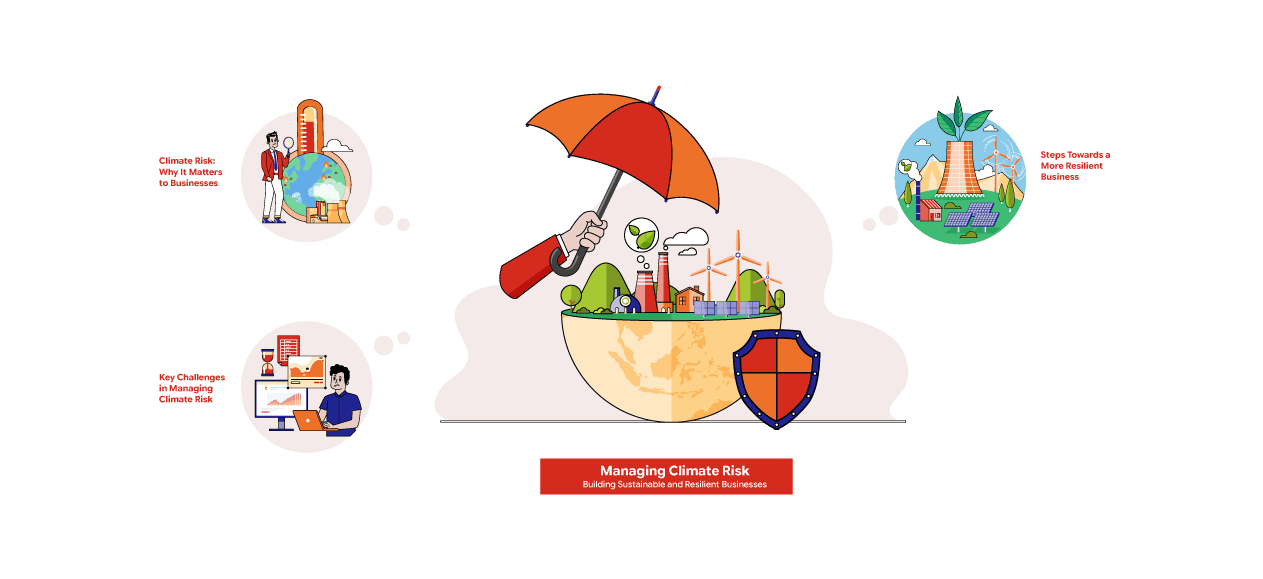
Climate Risk: Why It Matters for Businesses

So, what is climate risk exactly?Climate risk refers to the impact of environmental changes on a business’s operations, assets, and financial position. It is no longer a future risk, but a present reality that is increasingly complex and challenging in today’s business landscape.
In general, climate risk can be divided into two main categories:
- Physical risks
Physical risk refer to the direct impacts of climate change, including floods, heatwaves, and other extreme weather events. In Malaysia, phenomena such as flash floods and prolonged periods of extreme heat have had a significant impact on business operations, particularly across sectors such as retail, logistics, and transportation. These disruptions can affect operational continuity, employee safety, and a business’s ability to meet customer demand.
- Transition risks
Transition risk arises from changes in policies and regulations, market expectations, and new sustainability requirements related to business sustainability. The shift towards a low-carbon economy requires businesses to adapt their operating models, strategies, and investments more quickly. Failure to do so may result in negative implications for a company’s competitiveness and long-term viability.
Businesses that are not prepared to manage these risk may face:
- Rising operational costs
- Disruptions to supply chains
- Reputational challenges and loss of stakeholder trust
By understanding how climate change affects businesses, organisations can make more informed strategic decisions, strengthen operational resilience, and build sustainable and competitive business in the long term.
Key Challenges in Managing Climate Risk

Although awareness of climate change is increasing, many organisations still face difficulties in managing climate risk effectively. One of the main reasons is the nature of climate risk itself, which is not always clear or immediately visible. In many cases, the impacts of climate change occur gradually and over the long term, causing their implications for operations and financial performance to be underestimated.
In addition, a lact of resources, data and expertise remains a major challenge, particularly among small and medium-sized enterprises (SMEs). Without adequate support, guidance, or access to the right expertise, efforts to integrate sustainability into business strategies can be challenging and may require significant upfront investment.
Furthermore, short-term priorities such as revenue targets and immediate financial pressure often take precedence over the implementation of sustainable business initiatives. This situation leads to climate-related efforts being deferred, especially when regulations, policies, and stakeholder expectations are changing rapidly and require swift adaptation.
Without careful planning and a strategic approach, these challenges can increase the risk of unexpected operational disruptions and financial pressure.
Steps Towards a More Resilient Business

The positive aspect is that organisations do not need to implement major changes abruptly to address climate risk. Small, consistently applied steps are sufficient to create a meaningful long-term impact.
Below are several practical approaches to strengthening climate risk management in business:
1. Identify Potential Risks Early
The first step is to identify climate-related risks that may affect operations, assets, and supply chains. Early identification forms an essential foundation for the development of an effective and sustainable climate risk strategy.
2. Integrate Sustainability into Your Business Strategy
Sustainability should not be viewed as a standalone initiative. Instead, it should be integrated into core planning and overall business direction, ensuring that strategic decisions support a sustainable business model.
3. Improve Operational Efficiency
Small improvements in daily operations can deliver significant impact, including:
- Reduce energy consumption
- Minimizing waste
- Optimizing resource usage
These measures not only support efforts to address climate change but also help reduce operating costs and enhance business efficiency.
4. Consider Financial Protection and Risk Management Solutions
Climate-related risks may result in substantial financial losses. Appropriate financial protection and risk management mechanisms can help businesses manage uncertainty and maintain long-term financial stability.
5. Continuously Review and Adapt
The impact of climate change continues to evolve. Therefore, management strategies must be reviewed and adjusted regularly to ensure they remain relevant and effective in supporting business sustainability.
Why Climate Risk Management Matters More Than Ever
In Malaysia and across the Southeast Asian region, the impact of climate change have become increasingly evident and has had a significant effect on business operation and resilience. According to the World Bank (2023), climate-related risks have the potential to negatively affect overall economic growth if they are not managed effectively.
Furthermore, a report by the United Nations Environment Programme (2022) indicates that organisations which adopt sustainable business practices are in a stronger position to withstand long-term risks, including operational disruptions, financial pressures, and changing stakeholder expectations.
Therefore, it is clear that building sustainable businesses is no longer an option, but a strategic necessity to ensure business continuity, competitiveness, and growth in an increasingly challenging environment.
Moving Forward with Confidence
In managing climate risk, the focus is not only on addressing current challenges, but also on preparing for an increasingly uncertain future.
The implementation of small yet consistent actions can establish a strong foundation for building sustainable and resilient businesses. By prioritising business sustainability strategies and taking early action to address climate change risks, organisations not only safeguard their operations and assets, but also strengthen long-term resilience.
Make resilience a priority. Begin managing climate risks now to ensure your business remain relevant and continues to thrive in an ever-changing environment.
Frequently Asked Questions
1. What are two types of climate risks?
The two main types of climate risk are physical risk and transition risk. Physical risk includes events such as floods, heatwaves, and other extreme weather conditions, while transition risks relate to changes in regulations, market expectations, and new sustainability-related requirement which both are key considerations in climate risk management.
2. What is climate risk in business?
Climate risk refers to the impact of climate change on business operations, financial stability, and long-term business sustainability. These risks may affect businesses directly or indirectly, depending on the sector and geographic location.
3. How does climate change affect businesses in Malaysia?
In Malaysia, climate change can cause supply chain disruptions, increase operating costs, and lead to changes in customer demand. Sectors such as agriculture, retail, logistics, and transportation are among the most vulnerable to these impacts.
4. Why is climate risk management important?
Effective climate risk management enables businesses to minimise operational disruptions, safeguard financial stability, and adapt more confidently to evolving environmental conditions.
5. What is a climate risk strategy?
A climate risk strategy involves the process of identifying, assessing, and managing risks related to climate change, while integrating business sustainability into the organisation’s overall planning and strategic framework.
Reference:
- https://thedocs.worldbank.org/en/doc/9cab9295dcab97fe6290f52fcf3ed6b5-0360012025/original/Reconciling-Economic-Success-with-Climate-Risk.pdf#:~:text=The%20physical%20impacts%20of%20climate%20change%2C%20especially,be%2016%25%20lower%20than%20baseline%20by%202050.
- https://www.undp.org/sites/g/files/zskgke326/files/2022-07/UNDP%20Strategic%20Plan%202022-2025.pdf